Choose Wave if
- You want a free, MIT-licensed starter and are happy on Livewire and Filament.
- You want a blog, pages, a changelog and themes built into the app.
- You sell to individual users and do not need teams or seats.
A Wave alternative for Laravel 13
Wave is free, open source and actively developed. It is a serious option. The two differ in what they include: Wave has a blog and themes, Stack Toast has teams, more payment processors and a choice of frontend.
Facts checked on 11 November 2026. Written by the maker of Stack Toast.
Wave is a good free starter, so the reasons to look elsewhere are specific: you need teams and per-seat billing, you want React or Vue in place of Livewire, or you need a payment processor other than Stripe and Paddle.
Wave is an open-source SaaS starter kit from DevDojo, released under the MIT licence. Version 3.6 runs on Laravel 13 with Livewire 4, Volt, Folio and a Filament 5 admin panel. It was updated the day before this page was checked.
It includes sign-in with optional two-factor authentication and social login, roles and permissions tied to plans, Stripe or Paddle billing, user API keys, a blog, pages, a changelog, themes and plugins.
| Wave | Stack Toast | |
|---|---|---|
| Price | Free. | $199 for one edition, or $349 for all four editions with AI Cocktail. One payment. |
| Licence | MIT, open source. | Commercial. Unlimited projects, including client work. |
| Laravel version | Laravel 13, PHP 8.3 or newer. | Laravel 13, PHP 8.4 or newer |
| Frontend | Livewire with Volt and Folio. Filament for the admin panel. | Livewire, React (Inertia), Vue (Inertia) or API only. Four editions from one codebase. |
| Login and registration | Yes. | Yes. Email and password, magic links, email PIN, password reset and email confirmation. |
| Two-factor authentication | Yes. | Yes. Authenticator app, SMS through Twilio or email, with recovery codes. |
| Social login | Yes. | Yes. Google, GitHub, Facebook and X. |
| Teams | No. Not in its feature list. | Yes. Invitations, team roles, seat limits and ownership transfer. |
| Roles and permissions | Yes. Roles are linked to plans. | Yes. Roles and permissions, managed from the admin panel. |
| API access | Yes. API keys exchanged for JWT tokens. | Yes. Sanctum tokens with scoped abilities, plus an OpenAPI specification. |
| Subscription billing | Yes. Stripe or Paddle. | Yes. Stripe, Paddle, Lemon Squeezy and Coinbase Commerce behind one interface. |
| Per-seat billing | Not documented. | Yes. Per-seat billing, prorated where the processor supports it. |
| Admin panel | Yes. Filament, covering users, roles, plans and content. | Yes. Eleven areas, in every edition including the API one. |
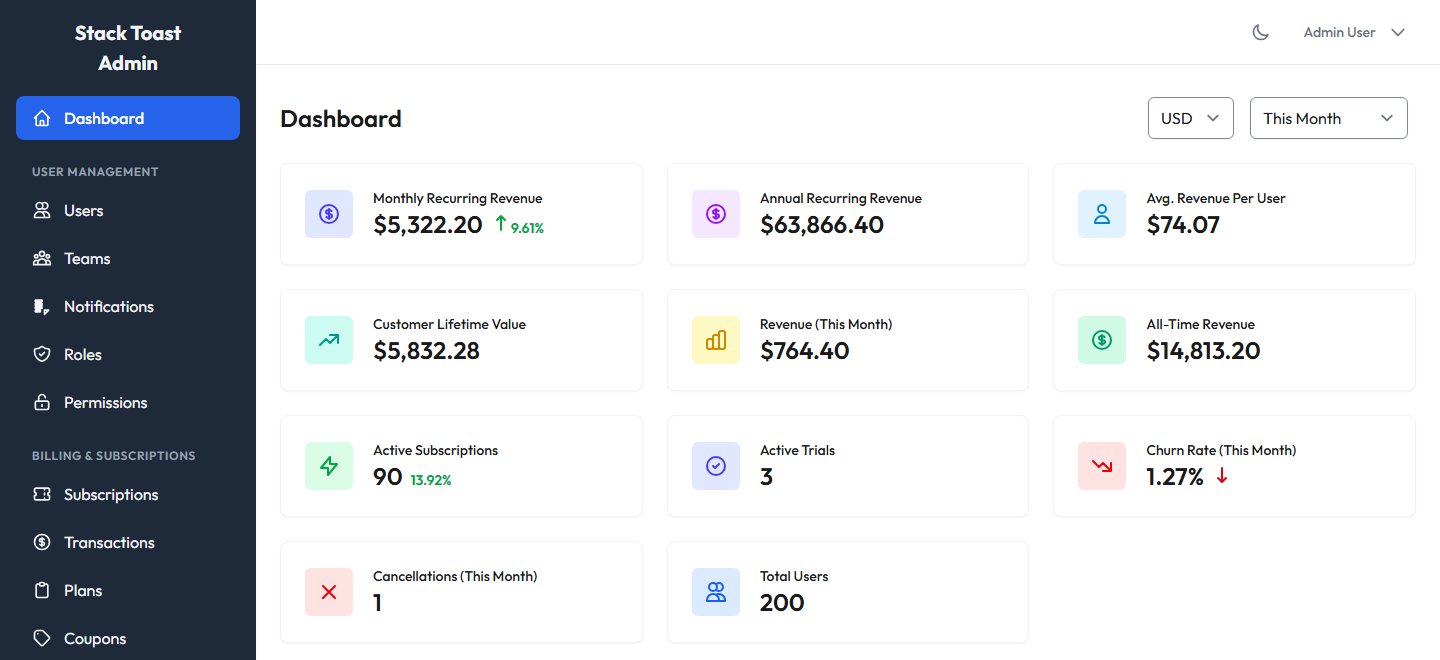
| Revenue metrics | No revenue dashboard is documented. | Yes. 22 metrics, including MRR, ARR, churn and lifetime value. |
| Blog and pages | Yes. Blog, pages and a changelog. | No, by design. A blog runs better on its own hosting, such as WordPress, where it does not use your application server. |
| Themes | Yes. Themes and plugins. | No theme system for marketing pages. The app has built-in colour themes. |
| Tests | Yes. A Pest test suite. | Yes. 1,684 automated tests ship with the code. |
| Updates | Manual. You replace the wave folder and re-apply admin changes by hand. | Releases arrive as a git merge. A command reports conflicts before anything changes. |
Wave details come from its own site and documentation, linked below. Products change, so check them before you buy.
If Wave covers what you need, you should not. The reasons to pay are specific: teams and seats, payment processors beyond Stripe and Paddle, revenue metrics, or a React, Vue or API-only frontend.
Teams are not in Wave's feature list. DevDojo documents a separate teams package, which you would integrate yourself. Check its current state before relying on it.
Wave documents a manual upgrade: you replace its folders and port your admin customisations. Stack Toast shares git history with its releases, and a command performs a trial merge and lists conflicts before anything changes. Either way, the fewer shipped files you edit, the easier upgrades are.
No, and that is deliberate. A blog is mostly public, cacheable content, and serving it from the application server spends resources your paying users need. Stack Toast expects the blog to run separately, for example on WordPress or a static site. If you would rather have the blog inside the same app, Wave includes one.
Authentication, billing through four payment processors, teams and a complete admin panel, in Livewire, React, Vue or API. Every screen is on the home page.